
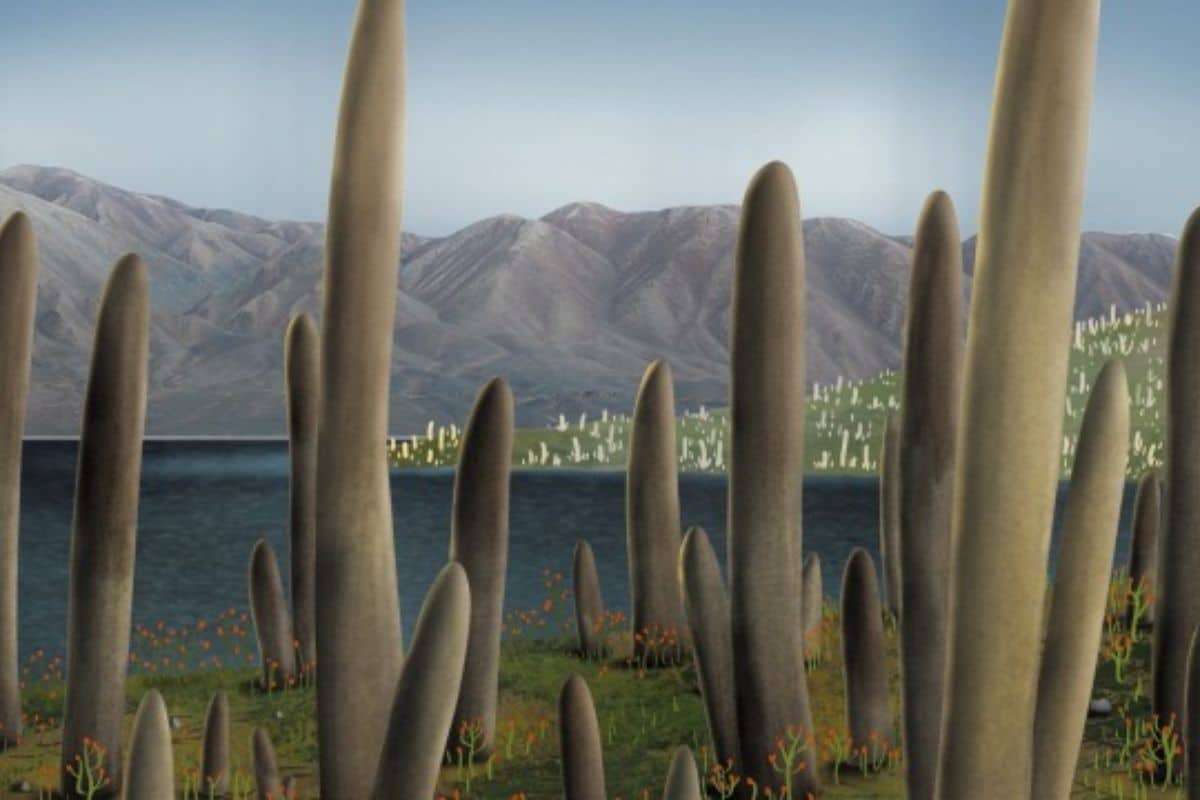
A mysterious fossil dating back 400 million years defies classification as a plant, animal, or fungus. Named Prototaxitess, this long-extinct organism has puzzled researchers for over 100 years. Recent research proposes it might represent an entirely novel branch of life that thrived on early Earth before disappearing from the record.
Early Titans of Terrestrial Ecosystems
Prototaxites flourished between 420 and 375 million years ago during the Silurian and Devonian periods, dominating the earth’s surface with enormous, tree-like structures that grew up to 8 meters tall and about a meter wide—far larger than other organisms of the era.
First discovered in 1843, these fossils were initially mistaken for decayed conifer remains. The debate over their identity—plant, giant algae, or fungus—continued for decades.
In 2007, Stanford University’s Kevin Boyce and his team analyzed the fossil’s carbon isotope signatures, leaning toward a fungal origin. Their findings indicated that Prototaxites didn’t produce energy via photosynthesis but absorbed carbon from decomposing organic material, much like fungi.

Could This Be a Completely New Form of Life?
The newest research, a preprint study led by Corentin Loron from the University of Edinburgh, examined the smaller species Prototaxites taiti found in Scotland’s Rhynie chert deposit.
More strikingly, chemical analysis comparing Prototaxites to true fungi from the same site revealed an absence of chitin, the key molecule forming fungal cell walls. Instead, the fossil exhibited traces of lignin-like substances, which are typically present in plants.
An Unclassifiable Branch of Life
Loron’s team described Prototaxites as large multicellular entities built from various tubular structures containing complex biopolymers similar to lignin and subsisting on decaying organic matter. According to the study, these traits are not known to coexist in any living organism today.
Kevin Boyce, who helped push the fungal hypothesis in 2007, acknowledged the shift: “Given the phylogenetic information we have now, there is no good place to put Prototaxites in the fungal phylogeny,” he said.
“Whether a fungus or something else altogether, this organism appears to represent a unique evolutionary experiment in complex multicellularity that has since vanished, lacking any multicellular lineage connection to modern life,” New Scientist reported.
Almost Otherworldly, but Earth-Born
The concept of now-extinct massive organisms that don't fit into any recognized kingdom adds a fascinating layer to our understanding of evolution. These "lost branches" may reveal the vast, untapped diversity of ancient life and highlight how much remains to be explored.
Brett Summerell of the Botanic Gardens of Sydney added a note of caution. “There are too many unknowns to say it is a unique lineage at this stage,” he said.
He pointed out that the assignment of Prototaxites to fungi had always been somewhat uncertain, particularly given its enormous size.
“The conclusion that it is a completely unknown eukaryote certainly creates an air of mystery and intrigue around it.”
- Categories:
- Science



0 comments
Sign in to Comment