
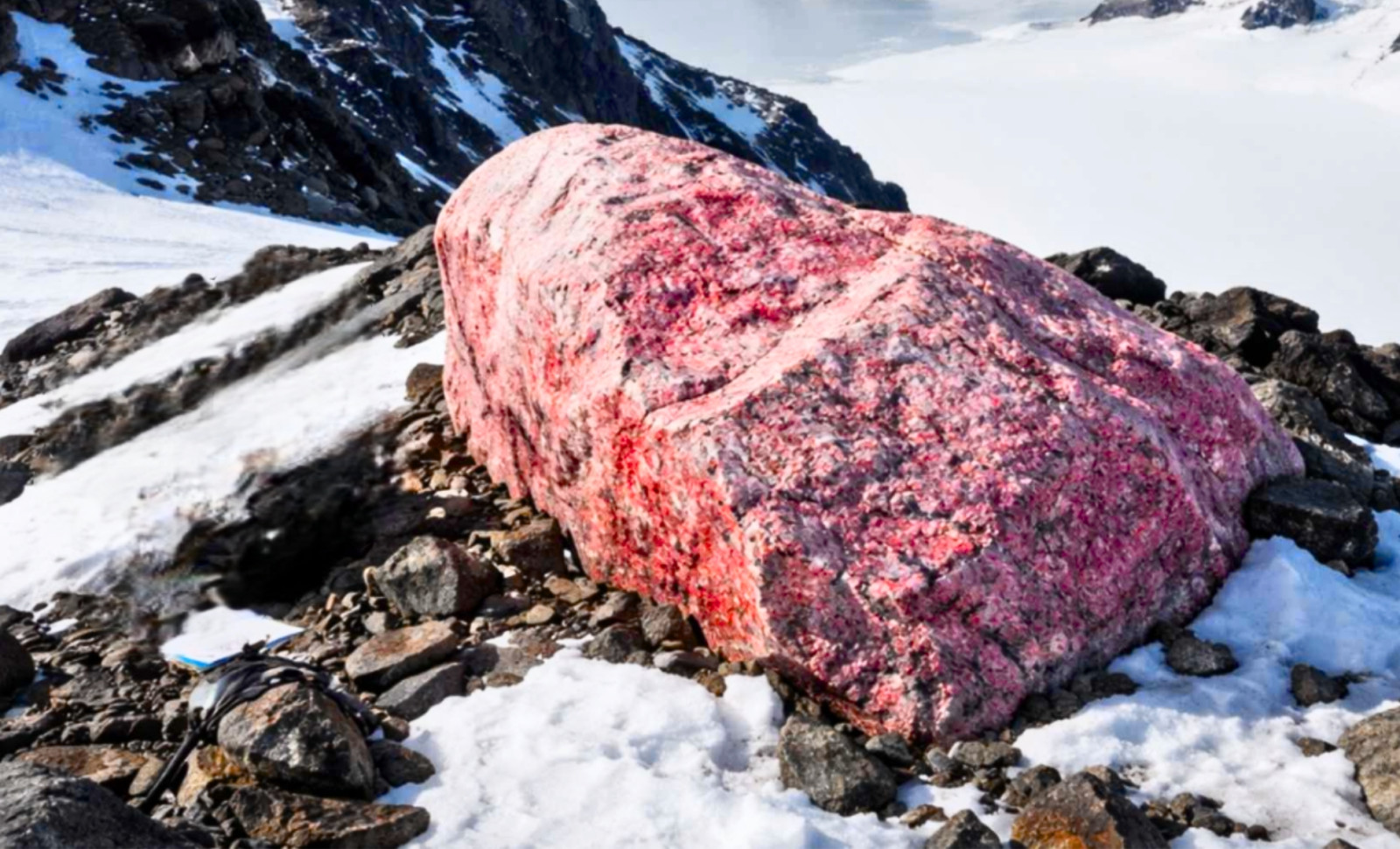
At the towering volcanic summits of the Hudson Mountains in West Antarctica, pale pink granite boulders prominently contrast the dominant black basaltic bedrock. These smooth, rounded stones seem oddly placed amidst the dark lava formations.
While scientists initially collected these erratics to study the ice sheet's history, recent research has revealed they indicate a far grander discovery: a vast granite massif nearly 100 kilometers across, buried beneath Pine Island Glacier for about 175 million years.
Glacial Erratics Point to a Hidden Granite Source
These distinctive rocks, known as glacial erratics, are rock fragments transported by moving glaciers and deposited far from their origins. According to the National Snow and Ice Data Center, erratics can travel immense distances carried by ice before being left behind during glacier retreat. In Antarctica, where thick ice blankets much of the land, such erratics offer rare clues about the bedrock lying below.

The pink granites in the Hudson Mountains stand out distinctly given the region’s younger volcanic basalt bedrock, formed from about 3 to 8 million years ago. The granite’s older age and unique chemistry show it was transported from a concealed source by glacial ice long ago.
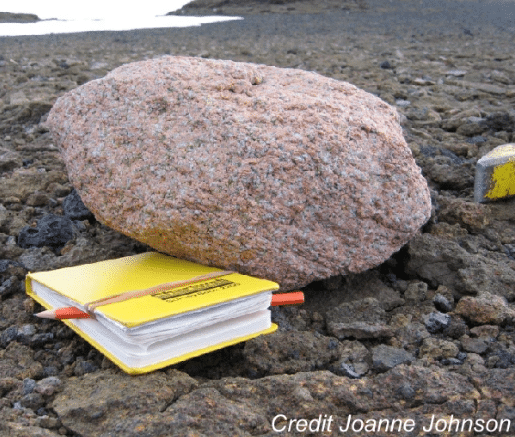
Scientists examined 12 granite samples, focusing on zircon minerals within them. These zircon crystals function as geological clocks, revealing the rock formation age. Five samples consistently dated back to roughly 175 million years ago, during the Jurassic period, an era when dinosaurs thrived and the supercontinent Gondwana began to break apart.
Other specimens reflected older Triassic ages and some younger Cretaceous periods, but the Jurassic signature prevailed. Lead researcher Tom Jordan from the British Antarctic Survey remarked, “The discovery of these pink granite erratics at the surface led us to an immense, concealed feature beneath the ice.”
Airborne Geophysical Data Exposed the Subglacial Granite
While the erratics revealed the rock type and age, they couldn't determine the body’s scale or precise location. To accomplish this, researchers collected airborne gravity and magnetic field data spanning the area.
Diverse rock types produce characteristic geophysical signals. Granite’s lower density causes gravity anomalies, while magnetic variations highlight mineral differences underground.
Correlating these geophysical patterns with zircon dating exposed a vast low-density zone beneath Pine Island Glacier and extending into the southern Hudson Mountains, consistent with a large granite deposit.
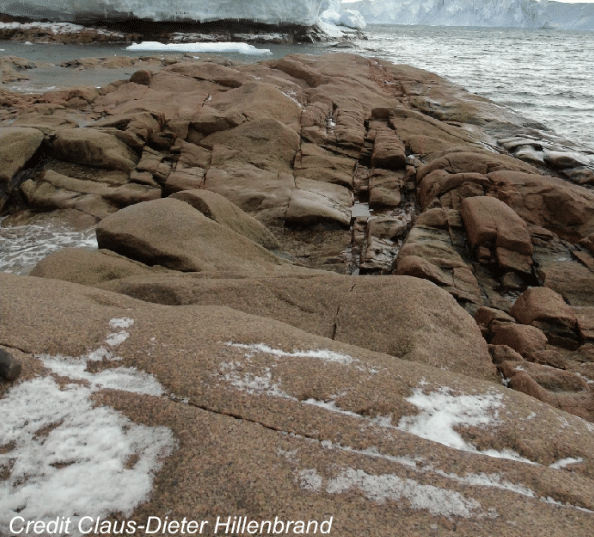
The data-driven model estimated this granite body to be approximately 100 kilometers in diameter and up to 7 kilometers thick, roughly half the size of Wales. Its position aligns closely with where erratics were collected, linking the surface discoveries to the buried formation.
Co-author Joanne Johnson emphasized the importance of this evidence: “These erratic boulders provide invaluable insights into the deep sub-ice geology that’s otherwise unreachable.”
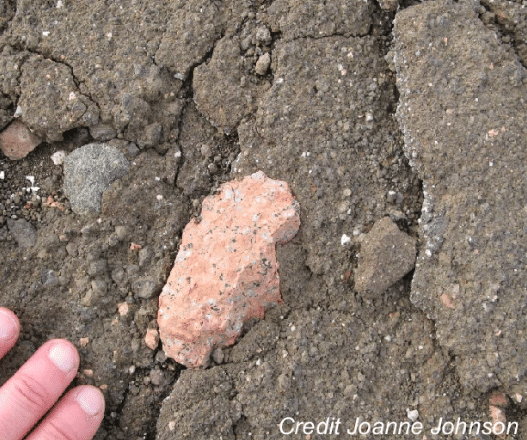
Additional support comes from field observations at World’s End Bluff, where granite fragments embedded in volcanic layers confirm the granite’s presence predates volcanic activity. Similar rocks appear at Sif Island near the glacier’s southern edge.
Insights into Past Ice Flow from Erratic Distribution
The spatial pattern of these erratics sheds light on historic glacial movement. Around 20,000 years ago, during the last glacial maximum, ice sheets thickened and expanded broadly over the Hudson Mountains. The Antarctic Glaciers initiative reports that Pine Island Glacier has been shrinking and speeding up in recent decades, underscoring the significance of understanding its prior dynamics.
As the glacier advanced, it eroded pieces of the granite below and transported them across the landscape. When the ice melted and receded, the erratics were left scattered atop volcanic ridges.
Striations etched into bedrock, scratches made by glacier movement, align with the north-south direction of ice flow that delivered the granite fragments from beneath Pine Island Glacier into the mountains.
Currently, ice flow in this Antarctic region is channeled through deep valleys rather than blanketing the terrain broadly. The presence and position of granite erratics record the prior, broader movement of the ice sheet. International research efforts like the International Thwaites Glacier Collaboration focus on further understanding these ice dynamics.
An Efficient Technique to Explore Hidden Geology
Direct bedrock sampling beneath Pine Island Glacier would require drilling through kilometers of dense ice, posing huge logistical challenges. Glacial erratics offer an indirect yet effective alternative.
In fact, over 3,500 erratic samples have been gathered across Antarctica, mostly for ice exposure dating, but they hold vast potential for mapping the continent’s hidden geology.
The pink granite boulders of the Hudson Mountains began their journey as Jurassic rocks, transported by moving ice, deposited atop volcanic peaks, and ultimately studied by geologists unknowingly tracing a massive buried granite formation. This concealed giant, spanning half the size of Wales, now enriches the geological understanding of West Antarctica.
The study was published in Communications Earth & Environment, a journal within the Nature family.
- Categories:
- Science


0 comments
Sign in to Comment