
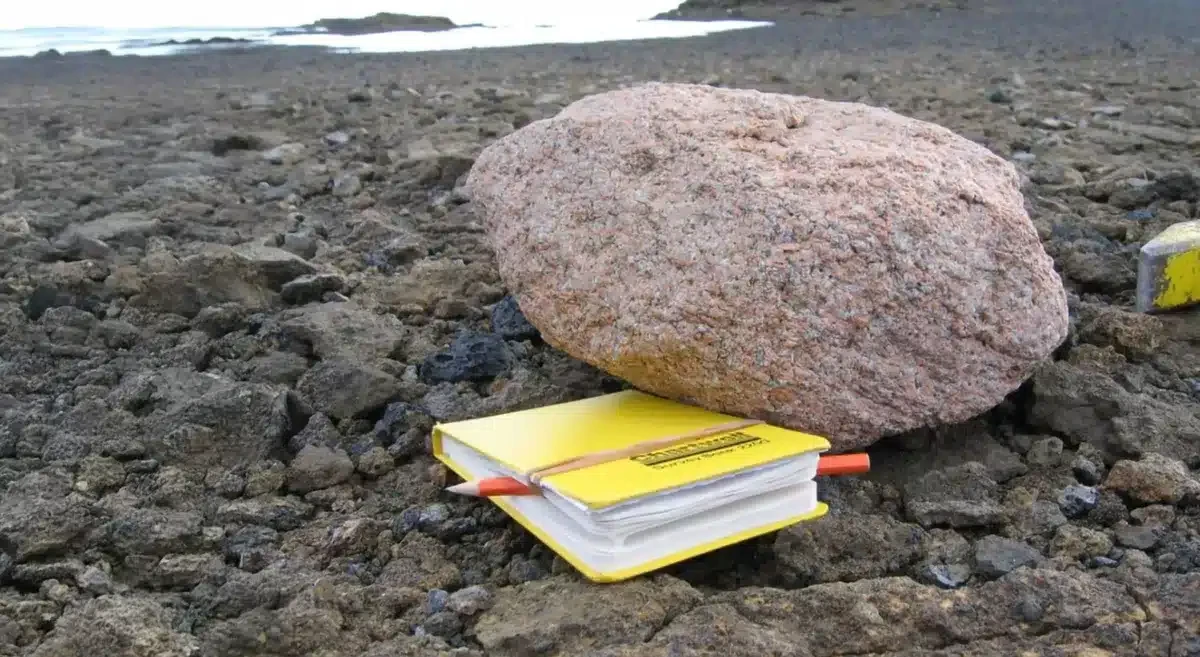
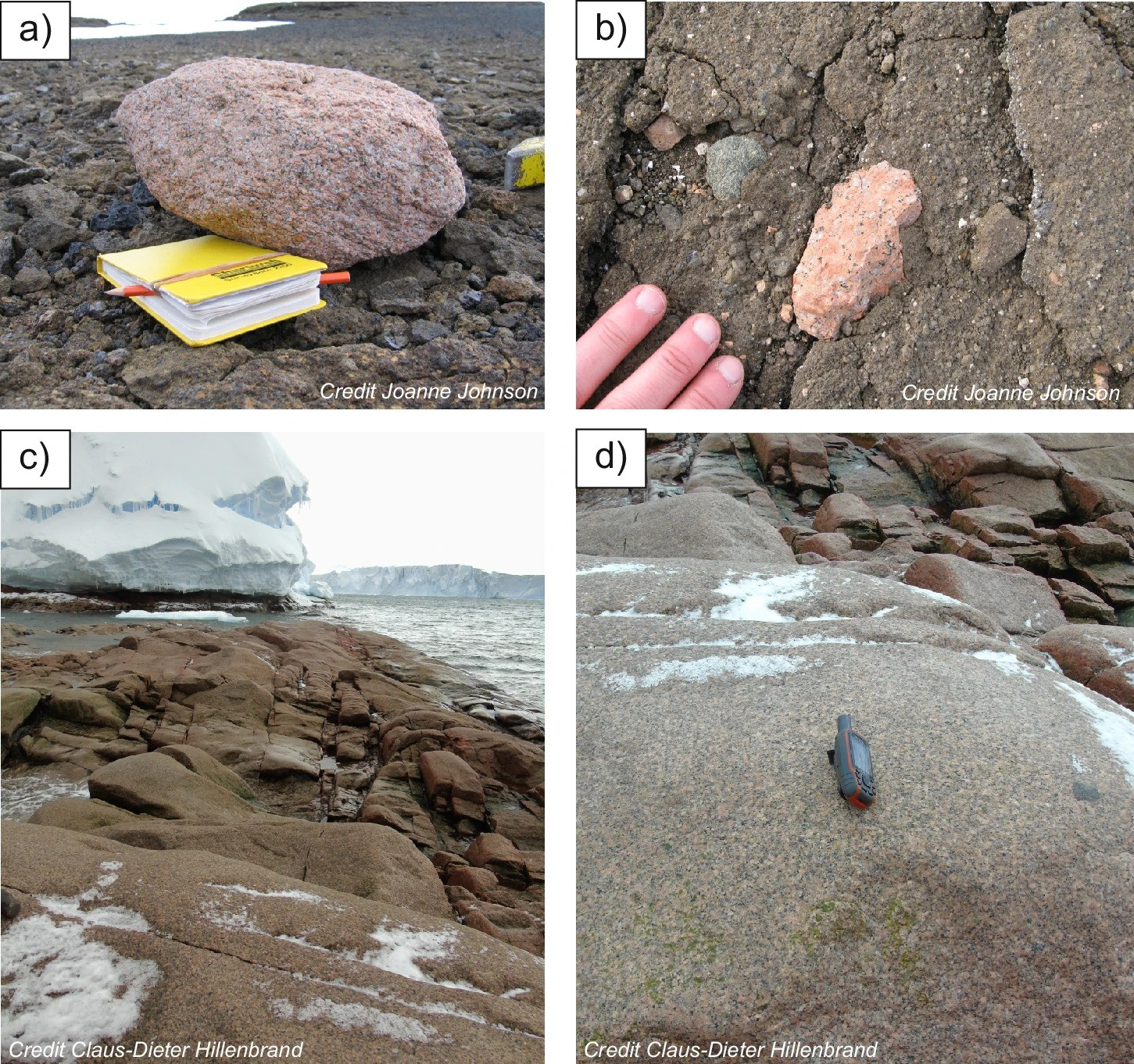
Striking pink granite boulders scattered atop peaks in West Antarctica’s Hudson Mountains have enabled researchers to uncover a vast granite massif concealed beneath the ice sheet. Initially noted as a geological curiosity, these vibrant rocks are now tied to an enormous underground structure extending beneath the Pine Island Glacier.
These distinctive boulders create a vivid contrast against the darker volcanic surroundings, capturing scientists’ attention during fieldwork. Their elevated location prompted an intriguing question: how did deep-seated granite emerge on mountain peaks exposed above the ice?
Utilizing rock analysis and airborne geophysical measurements, a team from the British Antarctic Survey (BAS) embarked on an investigation to trace the origin of these unusual stones.

Jurassic-Era Origins of the Pink Boulders
Dating techniques based on radiometric decay within mineral crystals revealed that the granite formed approximately 175 million years ago, in the Jurassic period. According to the British Antarctic Survey, this age clearly differentiates the granite from the younger volcanic rocks nearby.
This discovery suggests the granite was sourced from an ancient, buried formation beneath the ice rather than the surface volcanics. Consequently, researchers shifted focus to investigating the subglacial geology.
Detecting the Subsurface Granite Structure
To pinpoint the granite’s source, airborne surveys mapped delicate variations in Earth's gravitational field, exposing gravity anomalies beneath the southern part of the Hudson Mountains.
The research, detailed in the October 2025 issue of Nature Communications Earth & Environment, describes a massive formation roughly 100 kilometers across and 7 kilometers thick. Its dimensions and composition align with the pink granite fragments found atop the mountain peaks. As Dr. Tom Jordan, lead geophysicist at BAS and primary author, explained, integrating radiometric dating with gravity data connected isolated surface boulders to a vast hidden body. Dr. Jordan stated in a press release:
“It’s remarkable that pink granite boulders spotted on the surface have led us to a hidden giant beneath the ice.” He added that “by combining geological dating with gravity surveys, we’ve not only solved a mystery about where these rocks came from, but also uncovered new information about how the ice sheet flowed in the past and how it might change in the future.”
Tracing How Ice Relocated the Rocks
The explanation for these towering granite boulders involves glacier dynamics over millions of years. Classified as “glacial erratics,” these rocks were transported from their original location by glacial movement. While glaciers generally push debris downhill, shifts in glacier thickness, morphology, and flow direction can carry rocks in complex trajectories, even upward. Co-author Dr. Joanne Johnson remarked that the boulders serve as important markers documenting the history of Antarctic ice flow.
“Rocks provide an amazing record of how our planet has changed over time, especially how ice has eroded and altered the landscape of Antarctica. Boulders like these are a treasure-trove of information about what lies deep beneath the ice sheet, far out of reach.”
By pinpointing the granite's origin, researchers can further understand the past evolution of the West Antarctic Ice Sheet and better predict how it might respond to ongoing environmental changes.
- Categories:
- Science








0 comments
Sign in to Comment