
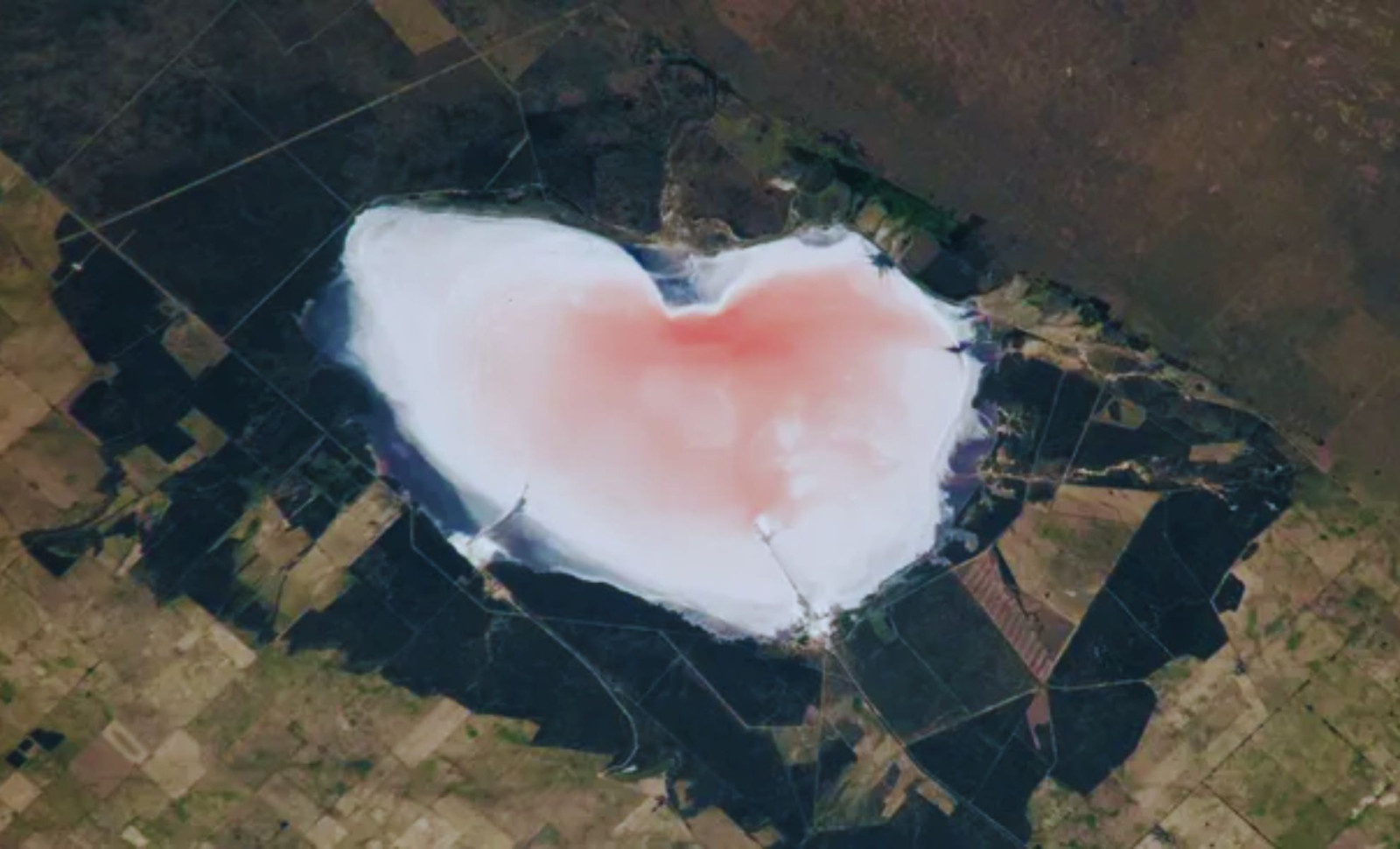
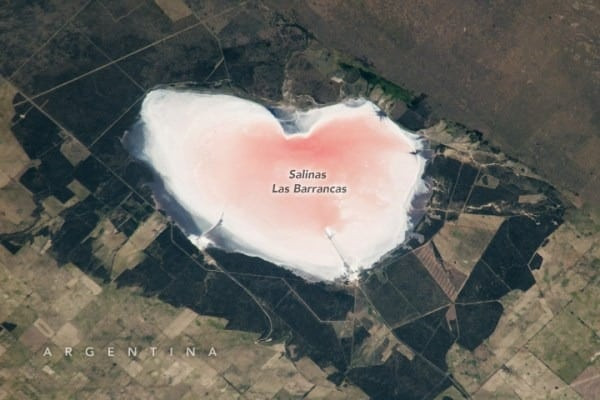
A stunning 2024 image taken by an astronaut showcases a heart-shaped saltwater lake glowing in pink hues in Argentina. NASA unveiled this captivating photo for Valentine’s Day 2025, drawing attention due to the lake’s vivid color and nearly perfect shape.
This lake, known as Salinas Las Barrancas or Laguna de Salinas Chicas, is located roughly 33 miles west of Bahía Blanca in the Buenos Aires province. It spans about 6 miles across and transforms dramatically with changes in rainfall and evaporation rates.
The lake’s appearance is influenced by active salt extraction and the presence of salt-loving microorganisms that flourish under extreme conditions, both factors affecting how it looks from space.

A Cycle of Filling and Drying Shapes the Landscape
Salinas Las Barrancas is a shallow body of water that replenishes during heavy rainfalls and gradually evaporates under intense sun. This natural cycle leaves behind thick salt crusts. As reported by the NASA Earth Observatory, this repetitive process maintains the region’s abundant salt deposits.
The astronaut’s photo reveals a lighter pink tint, indicating the lake was almost completely evaporated. At such times, the salinity peaks and water levels drop, altering the lake’s appearance noticeably.
Saltwater Microbes Give the Lake Its Distinctive Hue
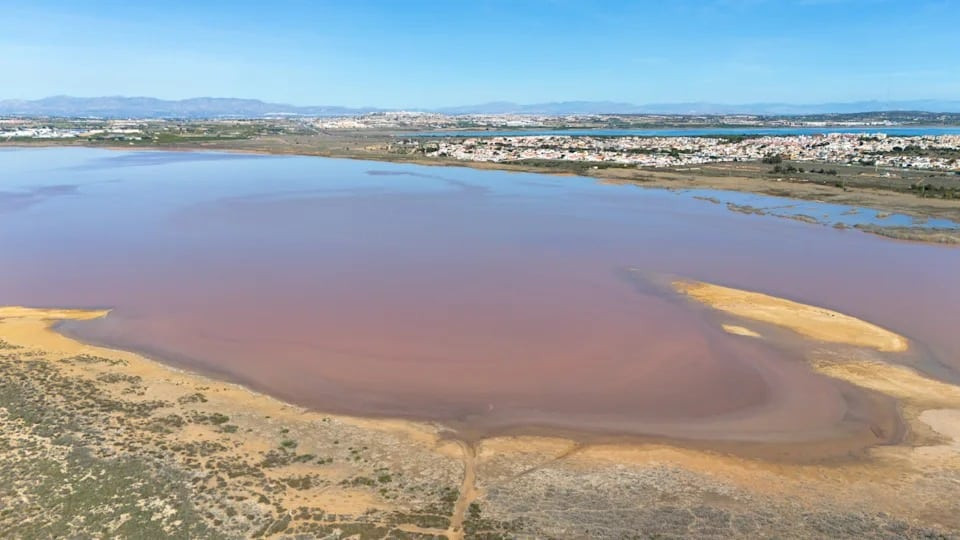
The coloration stems from microorganisms adapted to hypersaline environments. One notable organism, Dunaliella salina, is a type of algae that thrives under less extreme salinity and darkens the water to a reddish shade. Lilliam Casillas Martinez, a microbiology associate professor at the University of Puerto Rico at Humacao, explains:
“We have rainy seasons, when the salinity levels decrease [because there’s more water in the ponds]. When there’s less salt, the Dunaliella survives and the ponds look brownish-red.” she added: “During the dry season, it gets really salty. The Dunaliella dies and the archaea and bacteria take over. Then it becomes pink, pink, pink.”
Salt Mining and Wildlife Thrive Around the Lake
The site is also an active salt harvesting area. As highlighted by Live Science, local workers harvest up to 330,000 U.S. tons of salt annually, largely employing traditional manual scraping techniques between rains.
The intense sunlight reflecting off the bright salt flats creates challenging conditions. A salt harvester named Chepo described the environment as tough yet familiar, revealing how salt becomes part of daily life.
“The salt becomes part of your life,” he said. “For someone else, it’s a hellish place, but for me, the salt flats are my home; you get used to not being able to see.”
Despite the harsh environment, certain lifeforms endure. Salt-tolerant plants flourish near the shoreline, while birds like Chilean flamingos and yellow cardinals feed on carotenoid-rich crustaceans. These pigments, derived from algae such as Dunaliella, contribute to the birds’ vibrant plumage.
- Categories:
- Science




0 comments
Sign in to Comment