
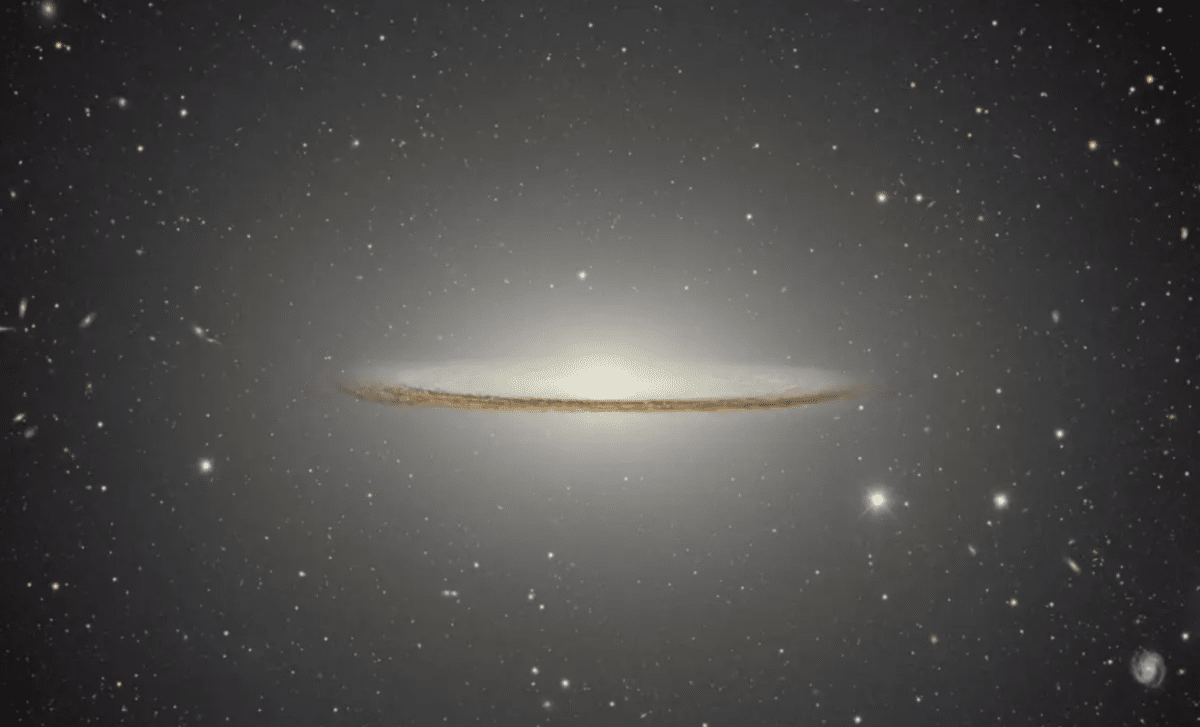
An astonishing new image of the Sombrero Galaxy is transforming astronomers’ perspectives on this iconic celestial object. Leveraging the remarkable capabilities of the Dark Energy Camera (DECam), scientists have captured an extraordinarily detailed portrait of the galaxy’s extensive outer regions, revealing faint features never before seen. As reported by NOIRLab, these observations uncover a sprawling luminous halo alongside remnants of the galaxy’s dynamic history, shedding light on how this enormous galaxy evolved over the course of billions of years.
An Iconic Galaxy Reveals a Vast, Hidden Extent
Situated approximately 30 million light-years away in the Virgo constellation, Messier 104, known widely as the Sombrero Galaxy, has captivated researchers with its brilliant central bulge and signature dusty ring, reminiscent of a sombrero’s brim. It stands as one of the most widely imaged galaxies and has been deeply examined by instruments including the Hubble Space Telescope and the James Webb Space Telescope. Yet, despite comprehensive study, the galaxy continues to reveal surprising new details.

The cutting-edge imagery from DECam, installed on the 4-meter Víctor M. Blanco Telescope at Chile’s Cerro Tololo Inter-American Observatory, discloses that the Sombrero Galaxy’s reach extends well beyond its prominent visible disk. What was once perceived as a compact galaxy is now known to be enveloped by an immense stellar halo stretching deep into the surrounding space. These dim stellar populations are notoriously difficult to detect with traditional instruments, making DECam’s sensitivity critical to this discovery. This revelation significantly enlarges the known boundaries of the galaxy and hints at a far more dramatic evolutionary past than previously imagined. By exposing hidden features in the galaxy’s outer darkness, astronomers are piecing together a more complete story of how this iconic galaxy came to be.

NOIRLab Reveals an Unprecedented Galactic Halo
The striking new image has garnered considerable attention for its extraordinary detail on the galaxy’s periphery. Released by NOIRLab (National Optical-Infrared Astronomy Research Laboratory), which manages several key U.S. astronomical facilities and programs, the image marks one of the most detailed captures of the Sombrero Galaxy’s expansive surroundings to date.
As NOIRLab conveyed:
“This image also reveals the galaxy’s immense luminous halo, which appears to extend more than three times the width of the Sombrero itself. This may be the first time this halo has been captured with such detail and on such a scale. DECam’s incredible sensitivity has also made it possible to detect a vast stellar stream stretching from the southern side of the galaxy. Both the halo and the stellar stream are composed of stars torn from their galaxies of origin, suggesting a past galactic merger between the Sombrero and a smaller satellite galaxy.”
This insight underscores the significance of the halo discovery—it is not merely a sparse collection of stars but a historical archive of ancient cosmic interactions. By analyzing the location and composition of these stars, scientists can reconstruct events from billions of years ago. The detected stellar stream is particularly important, as such formations commonly arise when a smaller galaxy is pulled apart and integrated into a larger companion. This evidence strongly supports the notion that the Sombrero Galaxy bears the marks of a significant merger that reshaped its structure indefinitely.
Clues to a Tumultuous History of Galactic Merging
Galaxies frequently evolve through encounters, interactions, and mergers, which can dramatically modify their shapes and redistribute vast numbers of stars. The recent DECam findings compellingly indicate that the Sombrero Galaxy underwent such an encounter. The expansive halo and stellar stream discovered around it are likely remnants of stars ripped from another galaxy during gravitational interaction.
These mergers are pivotal in how galaxies develop. As a smaller satellite galaxy approaches a larger host, tidal forces can strip stars from their original homes and disperse them through space. Over millions to billions of years, these stars merge into the larger galaxy’s halo, forming diffuse structures that preserve the record of past galactic collisions. Such features are faint and typically elude detection, but DECam’s extraordinary ability has revealed these elusive components after years of scrutiny.
This research also sheds light on why the Sombrero Galaxy harbors an unusually large number of globular clusters. With an estimated population of around 2,000 globular clusters, it far exceeds the roughly 150 clusters orbiting our own Milky Way. Many astronomers propose that such mergers contribute by delivering additional clusters during the accretion of smaller galaxies. These new observations strengthen the understanding that the Sombrero’s present form stems from a long, intricate evolutionary saga.
- Categories:
- Astronomy










0 comments
Sign in to Comment