

Researchers have detected volcanic glass beads within lunar soil samples, demonstrating that volcanic eruptions on the Moon continued until as recently as 123 million years ago. This represents the youngest volcanic event documented on the Moon, contradicting previous beliefs that such activity ended billions of years earlier. The discovery was reported in Science.
For many years, scientists held that lunar volcanism ceased about 2.8 billion years ago based on Apollo mission samples. However, findings from China’s Chang’e-5 mission, which brought back lunar soil in late 2020, indicate that volcanic activity lasted much longer than previously thought.
The Role of Chang’e-5 in Unveiling Lunar Volcanism
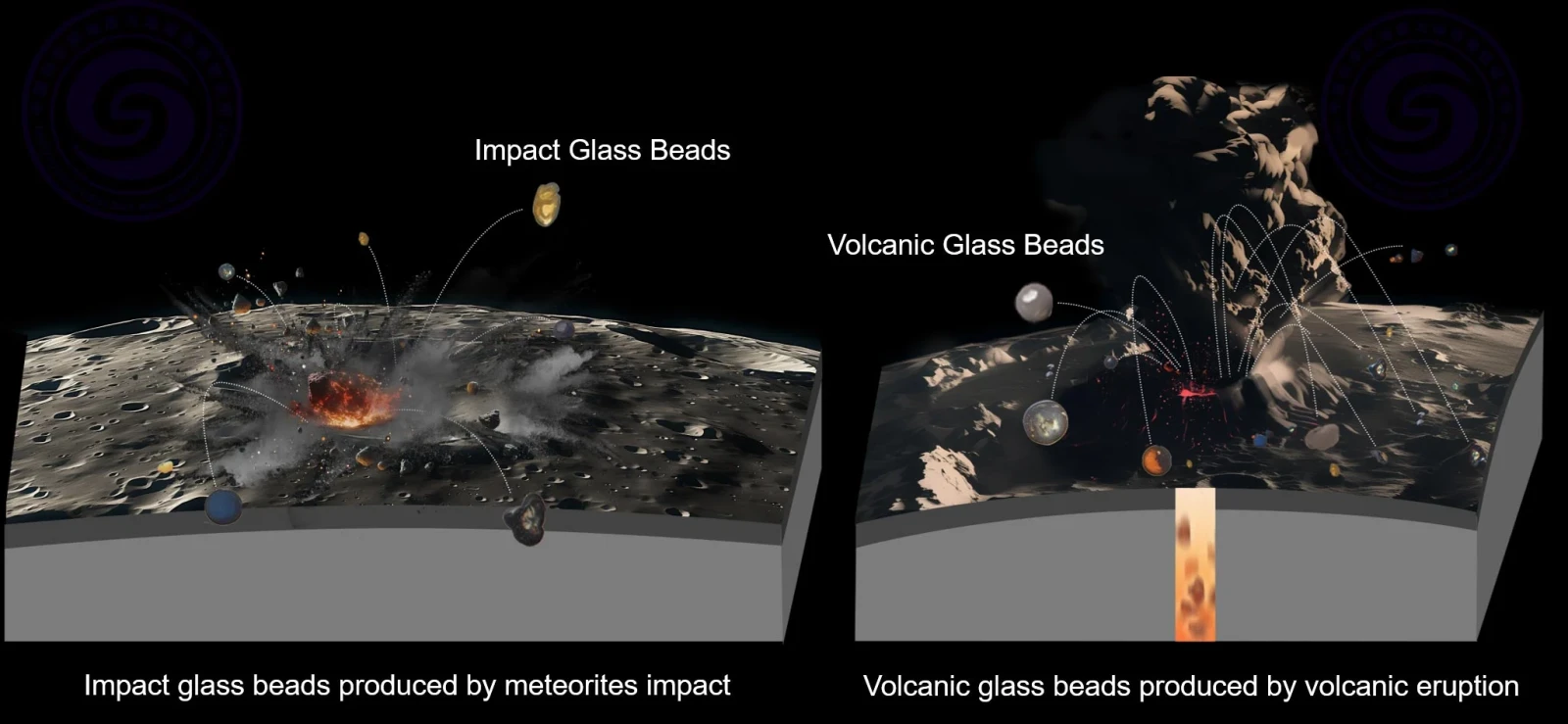
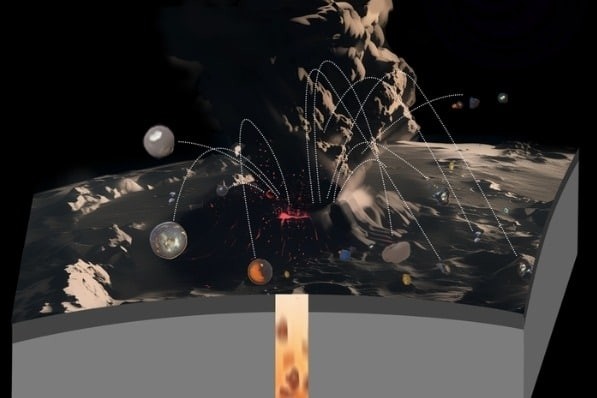
The key development arose from the Chang’e-5 mission by China’s space agency, which returned Moon soil samples in December 2020. Experts at the Institute of Geology and Geophysics, Chinese Academy of Sciences (IGGCAS), identified volcanic glass beads within these samples. These beads, produced during volcanic eruptions as recently as 123 million years ago, formed when gas-rich magma explosively cooled. Cutting-edge analytical methods confirmed their volcanic nature.

This study, published on September 5, 2024, involved sulfur isotope and chemical analyses to differentiate these beads from those generated by meteorite impacts, a major focus of earlier lunar investigations. This approach allowed precise dating of the volcanic glass.
“There is a ~1.9-billion-year gap between eruptions recorded at the landing site. The presence of such young lunar volcanism implies that small celestial bodies, such as the Moon, could maintain sufficient heat to sustain internal vitality until the very late stage,” explained Yuyang He, a geophysicist from the Institute of Geology and Geophysics at the Chinese Academy of Sciences.
Volcanic Glass Beads Confirm Recent Lunar Eruptions
These volcanic glass beads form when magma explosively erupts, cooling rapidly into glass fragments. Typically tiny—measuring less than a millimeter—these particles can be transported across large distances and remain preserved in lunar soil for millions of years.
The study verified that the beads found in Chang’e-5 samples differ chemically and isotopically from impact-generated glass beads, confirming a volcanic rather than meteorite origin. In total, the researchers analyzed approximately 3,000 glass beads and identified three volcanic ones, which were dated using uranium-lead techniques.
Implications for Lunar Interior and Thermal History
Prior studies suggested the Moon’s interior had cooled and become geologically dormant billions of years ago. Nevertheless, these new volcanic findings imply that internal geological processes continued later than expected.
“It is unclear how the Moon could have remained volcanically active at such a late stage; as the interior cooled and the lithosphere thickened, volcanic activity would have become less likely,” he said.
This discovery prompts scientists to rethink existing lunar geological models, especially concerning internal heat retention and how long volcanic activity persisted.
“Where were those volcanic glass beads from? Is there other volcanic activity between 2 billion and 120 million years ago? What mechanism caused it? Further investigations are needed.”
Ongoing analysis of materials from the Chang’e-5 mission is expected to shed more light on the Moon’s volcanic timeline and internal evolution.
- Categories:
- Astronomy






0 comments
Sign in to Comment