
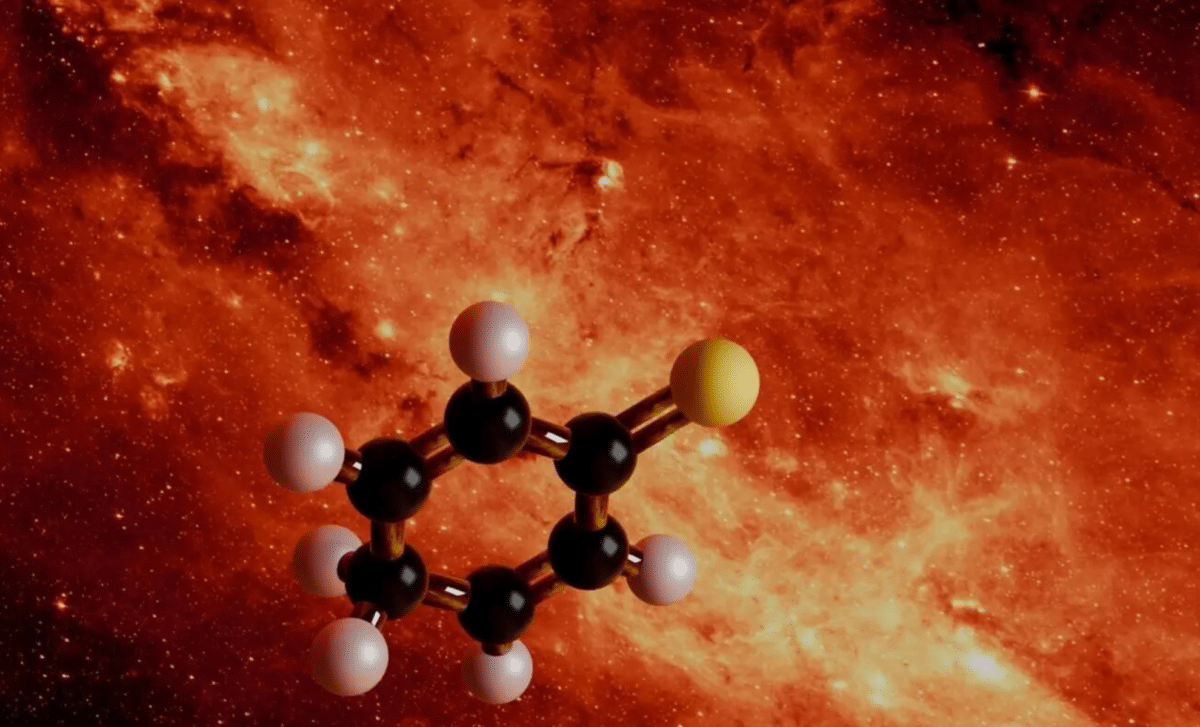
Scientists from the Max Planck Institute for Extraterrestrial Physics (MPE) and the Centro de Astrobiología (CAB) have revealed the discovery of the largest sulfur-containing molecule identified to date in the cosmos. This molecule, 2,5-cyclohexadiene-1-thione (C₆H₆S), was located within the molecular cloud G+0.693–0.027, situated near the heart of the Milky Way, about 27,000 light-years away from Earth. The discovery, which blends advanced laboratory spectroscopy with radio astronomical observations, appeared in Nature Astronomy.
Unveiling a Unique Sulfur-Bearing Molecule
This unprecedented molecule, C₆H₆S, features a six-carbon ring structure incorporating a single sulfur atom, resulting in a stable compound with 13 atoms. Its complexity and size exceed those of all sulfur molecules previously detected in interstellar space, which generally contained no more than six atoms.
The identification of this molecule marks a pivotal development in astrochemistry, confirming that intricate sulfur-based ring structures, previously hypothesized, can form in the harsh, cold environments of space, even where star formation has not yet begun.

“This is the first unambiguous detection of a complex, ring-shaped sulfur-containing molecule in interstellar space and a crucial step toward understanding the chemical link between space and the building blocks of life,” says Mitsunori Araki, lead author of the study and scientist at MPE.
This discovery also fills a significant missing piece in our understanding of solar system chemistry. Until now, such ring-like sulfur molecules had only been found in meteorites and comets. Finding a molecule with an analogous structure deep in space suggests a chemical continuity between interstellar clouds and the primordial material that formed our solar system.
A Breakthrough in Molecular Astronomy
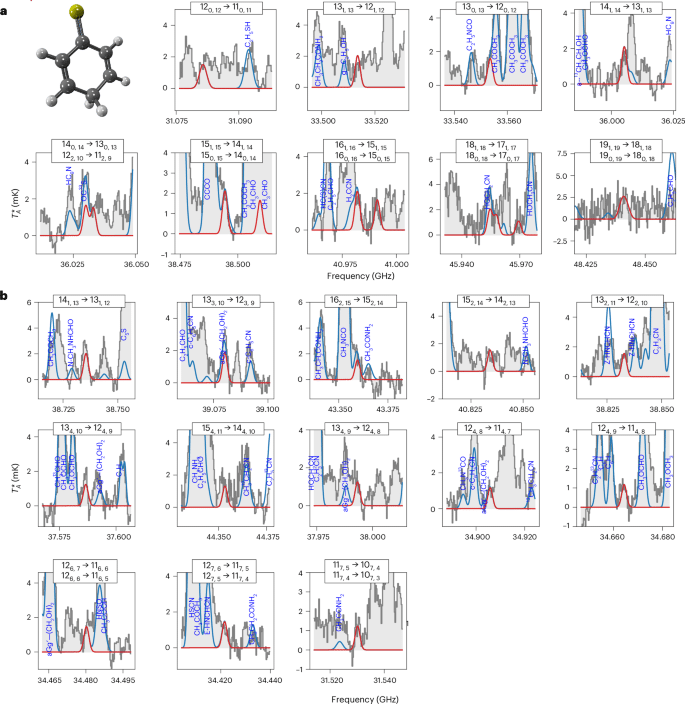
Published in Nature Astronomy, this research integrates laboratory innovation with precise extraterrestrial observation. At MPE, scientists created the molecule by applying a 1,000-volt discharge to thiophenol (C₆H₅SH), a sulfur-rich compound known for its distinctive odor. This plasma formation facilitated the synthesis of C₆H₆S under controlled laboratory conditions.
Employing a custom-designed spectrometer, the team recorded the molecule's specific radio emission signature with exceptional precision, pinpointing details down to seven significant figures. This distinct spectral fingerprint was then compared with data obtained from the IRAM 30m and Yebes 40-meter radio telescopes in Spain. The exact correspondence confirmed the molecule’s presence in the G+0.693–0.027 cloud, a region where star and planet formation is in its earliest stages.
The use of tailored experimental equipment was critical to this success. The team’s approach involved synthesizing and analyzing the molecule within a large vacuum chamber, setting a new standard for the field of molecular astrophysics by directly linking lab synthesis with cosmic observation.
Implications for Origins of Life Research
Finding C₆H₆S presents significant insights into how prebiotic compounds may assemble long before celestial bodies come into being. The molecular cloud where it was identified remains in a nearly pristine, starless state, providing an ideal setting to examine the earliest chemistry that could lead to life.
“Our results show that a 13-atom molecule structurally similar to those in comets already exists in a young, starless molecular cloud. This proves that the chemical groundwork for life begins long before stars form,” says Valerio Lattanzi, another researcher at MPE.
The molecule’s survival and detection in such an environment strongly support the hypothesis that complex, life-related chemistry starts in the depths of space, not merely within mature solar systems.
Sulfur is essential for biological functions on Earth, especially in enzymes and proteins, and the discovery of complex sulfur compounds in the interstellar medium suggests that exoplanetary systems may also benefit from similar chemical foundations. This breakthrough raises the possibility that numerous other sulfur-based molecules remain concealed in space, potentially forming the chemical seeds for life elsewhere in the universe.




0 comments
Sign in to Comment