

Researchers have achieved a groundbreaking observation by detecting a near-light-speed jet in Markarian 110, an active galaxy with minimal radio emission. Detailed results were presented in a study published on arXiv on June 4, 2025. Utilizing Very Long Baseline Interferometry (VLBI) techniques involving the Very Long Baseline Array (VLBA) alongside the European VLBI Network (EVN), astronomers captured exquisite details of this galaxy's jet dynamics. These insights advance our comprehension of how jets arise and behave within radio-quiet active galactic nuclei (AGNs), opening new avenues in astrophysical jet research.
An Overview of Markarian 110: A Distinct Radio-Quiet AGN
Markarian 110, or Mrk 110, is notable for being a radio-quiet AGN, characterized by its relatively faint radio emission compared to typical AGNs. Situated at a redshift of 0.035, it belongs to the Narrow-Line Seyfert 1 (NLS1) class—a subset of AGNs defined by strong ionized iron lines, narrow Balmer emission profiles, and pronounced X-ray activity. These qualities make Mrk 110 a critical target for investigating complex mechanisms operating near the centers of active galaxies.
The galaxy exhibits an irregular structure, likely resulting from a recent merger or galactic interaction. Furthermore, its highly variable and compact central region continues to captivate researchers, providing a natural laboratory to explore how weak radio signals are generated and how relativistic jets might form under such conditions.

Insights from Recent Jet Observations
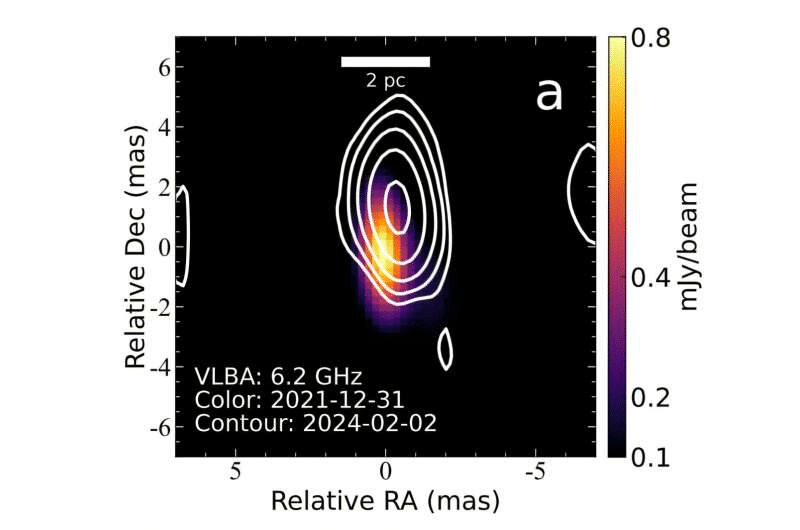
Combining multi-frequency VLBI data (1.6, 4.7, 4.9, and 7.6 GHz), the team, led by Ailing Wang at the Chinese Academy of Sciences, examined Mrk 110 over nearly a decade, from 2015 to 2024. Their analysis uncovered episodic jet activity during two main intervals: 2015-2016 and 2022-2024. Data from the initial period captured a prominent jet ejection event, with the jet noticeably shifting toward the northwest, demonstrating tight coupling between jet dynamics and the evolving galactic environment.
The latest measurements spanning 2023-2024 revealed jet speeds exhibiting apparent superluminal motion, marking some of the fastest jets detected in a radio-quiet AGN. Intriguingly, this high velocity slows down at region roughly 10–20 light years from the galactic nucleus, highlighting the complex interplay of forces acting on jets over vast spatial scales.
Interpreting Jet Evolution Through Spectral Changes
The evolution of the jet’s radio spectrum offers vital clues about the underlying physics. As the jet advances outward from the core, its spectral index transitions sharply from a steep gradient to an inverted profile—information that deeply enriches jet modeling. According to the authors, “The observed spectral progression in Mrk 110 quantitatively matches the theoretical models of evolving self-absorbed synchrotron emission in nascent jets, with the inverted spectrum precisely corresponding to the canonical value for optically thick synchrotron emission from a homogeneous source.”
This shift in spectral characteristics indicates that the jet undergoes substantial physical transformations during propagation. The inverted spectral signature is characteristic of optically thick synchrotron emission, a fundamental mechanism in radio jet studies. Theoretical frameworks incorporating self-absorbed synchrotron emission robustly explain these observed shifts, revealing the complex life cycle of relativistic jet material.
- Categories:
- News













0 comments
Sign in to Comment