

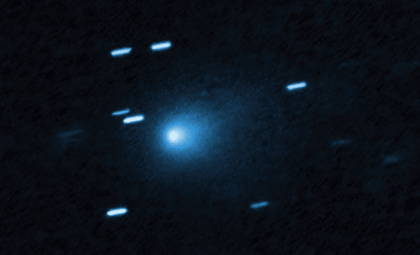
Scientists have long been fascinated by the prospects of studying interstellar visitors, and a new mission concept aims to intercept the well-known comet 3I/ATLAS. This daring proposal employs the Oberth effect, a maneuver that could propel a spacecraft beyond 700 astronomical units from the Sun by leveraging a series of gravitational assists, including a close solar flyby.
Harnessing the Oberth Effect to Propel Spacecraft Further
Central to this mission design is the Oberth effect, a phenomenon first described by rocket pioneer Hermann Oberth. The concept exploits the gravitational pull of a massive body like the Sun to boost spacecraft velocity. As the spacecraft dives into the Sun's gravitational well, it accelerates, and at its closest point, or periapsis, it fires its engines to gain maximum thrust.
“Pretty much every launch uses the Oberth effect,” said T. Marshall Eubanks, a former NASA scientist and one of the authors of the mission paper. “It’s why, for example, missions such as Artemis 2 do their translunar injection burns at perigee, not apogee. That’s an Oberth maneuver. However, I cannot find a record of a straight-out Oberth maneuver of the type we propose, which is a major rocket burn at closest approach in a flyby.”
Add Cosmo Herald as a Preferred Source

Executing this maneuver demands the spacecraft to approach within 0.015 AU of the Sun, deep inside the solar corona. Here, temperatures reach extremes above 2,500°F (1,370°C)—conditions akin to those encountered by NASA’s Parker Solar Probe. To endure this intense heat, the craft would require cutting-edge heat shielding made from materials like carbon composites and aerogel, technologies inspired by the Parker probe.
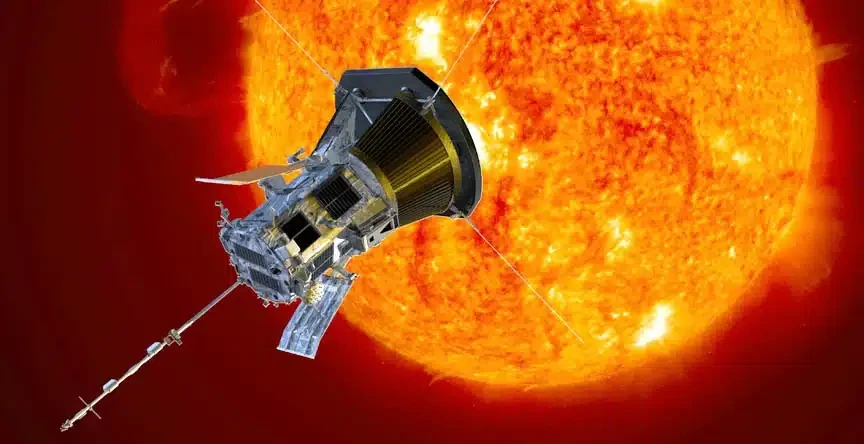
Gravity Assists: Fine-Tuning Trajectory for Maximum Velocity
Successful navigation hinges on the spacecraft’s ability to adjust its speed and trajectory using gravity assists. Initially, it will make a journey to Jupiter, where the planet’s gravity will be exploited to decelerate the spacecraft. Though counterintuitive, reducing the speed is crucial to allow a proper solar flyby since departing Earth with excessive velocity would prevent the required close solar approach.
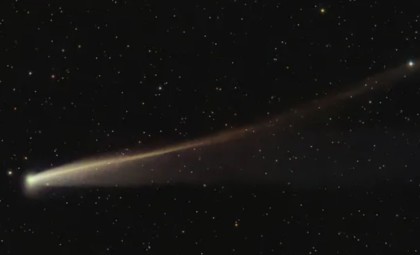
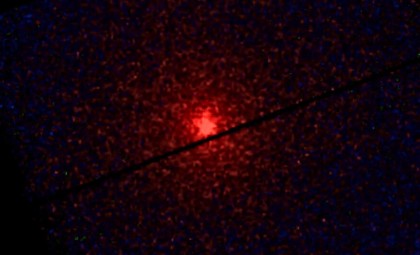
Eubanks emphasized, “Pretty much every launch uses the Oberth effect,” highlighting its foundational role in space travel. This mission, however, plans an unprecedented application: a significant engine burn during the closest solar passage, enabling it to catch up with 3I/ATLAS—a comet speeding away at over 38 miles per second. Without this high-velocity burst, intercepting such a swift target would be nearly impossible.
Following the gravity-assist sequence and the solar Oberth maneuver, the spacecraft would set off on a multi-decade voyage to meet 3I/ATLAS. Traveling at record-breaking speeds, the probe could potentially intercept the comet by 2085—a monumental accomplishment. The details of this ambitious project are outlined in a study available on arXiv.
Mission Duration and Technical Hurdles Facing 3I/ATLAS Chase
Reaching 3I/ATLAS is a long-term endeavor rather than a quick sprint. Calculations indicate that achieving a velocity change (delta-V) of 5.1 miles per second would bring the spacecraft to the comet in roughly 50 years. Enhanced velocity via the Oberth maneuver could shrink this timeframe to around 30 years.
Many obstacles remain, as Eubanks observed,
“We’ll just have to see… maybe after 10 interstellar objects have been found, 3I will seem commonplace and it won’t seem worthwhile to mount an expedition to chase it.”
The realm of interstellar travel is evolving rapidly, and what now appears groundbreaking might become standard practice as technology evolves, potentially easing future missions’ complexity and cost.
Assessing the Solar Oberth Maneuver's Risks and Alternatives
A major challenge of this plan lies in the inherent risks of the solar Oberth maneuver. Although highly effective, it is designed to catch an object that is already moving away from the Sun, meaning the spacecraft will be trailing the comet far beyond the solar system’s inner regions.
“For future interstellar objects, a solar Oberth maneuver should be avoided if possible,” said Adam Hibberd, a leading researcher in the field. “It is designed to catch a specific interstellar object ‘after the bird has flown’ and it is heading away from the sun… there are better mission architectures, using a probe already in orbit in space, which would intercept an interstellar object around perihelion in much less time, rendering an Oberth unnecessary.”
Nevertheless, the enthusiasm for exploring these exotic visitors remains strong. Eubanks expressed confidence, stating,
“I feel quite confident that when we develop the ability to reach these interstellar objects, there will be a strong desire to directly explore at least some of them.”
As discoveries of interstellar objects increase, missions like this pave the way toward future interstellar exploration, expanding humanity's reach into the cosmos.
- Categories:
- Space




0 comments
Sign in to Comment