
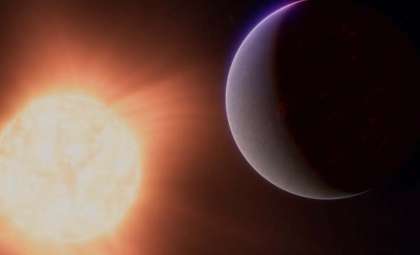
Astronomers have unveiled TOI-1452 b, an exoplanet situated roughly 100 light-years away that may harbor vast quantities of water. Its size, mass, and density suggest it could be one of the most promising ocean planets discovered to date.
This planet revolves around a diminutive star within a binary system in the constellation Draco. The identification combined observations from NASA’s TESS satellite and multiple terrestrial telescopes.
TOI-1452 b is somewhat larger and significantly denser than Earth, boasting an estimated mass near five times Earth's. Its orbital path keeps it close enough to its star to potentially support liquid water on its surface.

Initial Detection Through TESS
The discovery started with data from NASA’s TESS mission, which detects exoplanets by monitoring minute variations in stellar brightness. According to the Université de Montréal, scientists spotted a repeated dimming occurring every 11 days, hinting at a planet approximately 70% larger than Earth.
Validating the signal posed a challenge since the host star belongs to a binary system, and TESS interprets light from both stars as a single point. To determine the exact source, researchers employed the PESTO camera at the Observatoire du Mont-Mégantic.
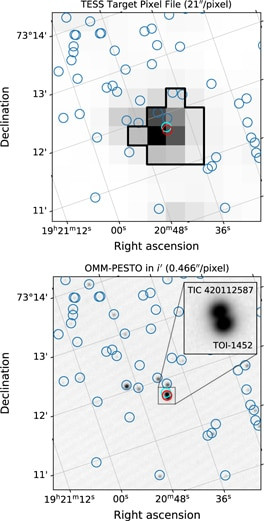
These observations confirmed the planet is orbiting the system’s larger star.
“This was no routine check,” Charles Cadieux from the Université de Montréal said, “We had to make sure the signal detected by TESS was really caused by an exoplanet circling TOI-1452.”
An Alien World Unlike Earth
After confirmation, astronomers utilized the spectropolarimeter SPIRou at the Canada-France-Hawaii Telescope to measure the planet’s mass, dedicating over 50 hours of observation time.
Results show TOI-1452 b carries nearly five Earth masses. To isolate its subtle signal, researchers applied the LBL method, a data processing technique pioneered by Étienne Artigau and Neil Cook.
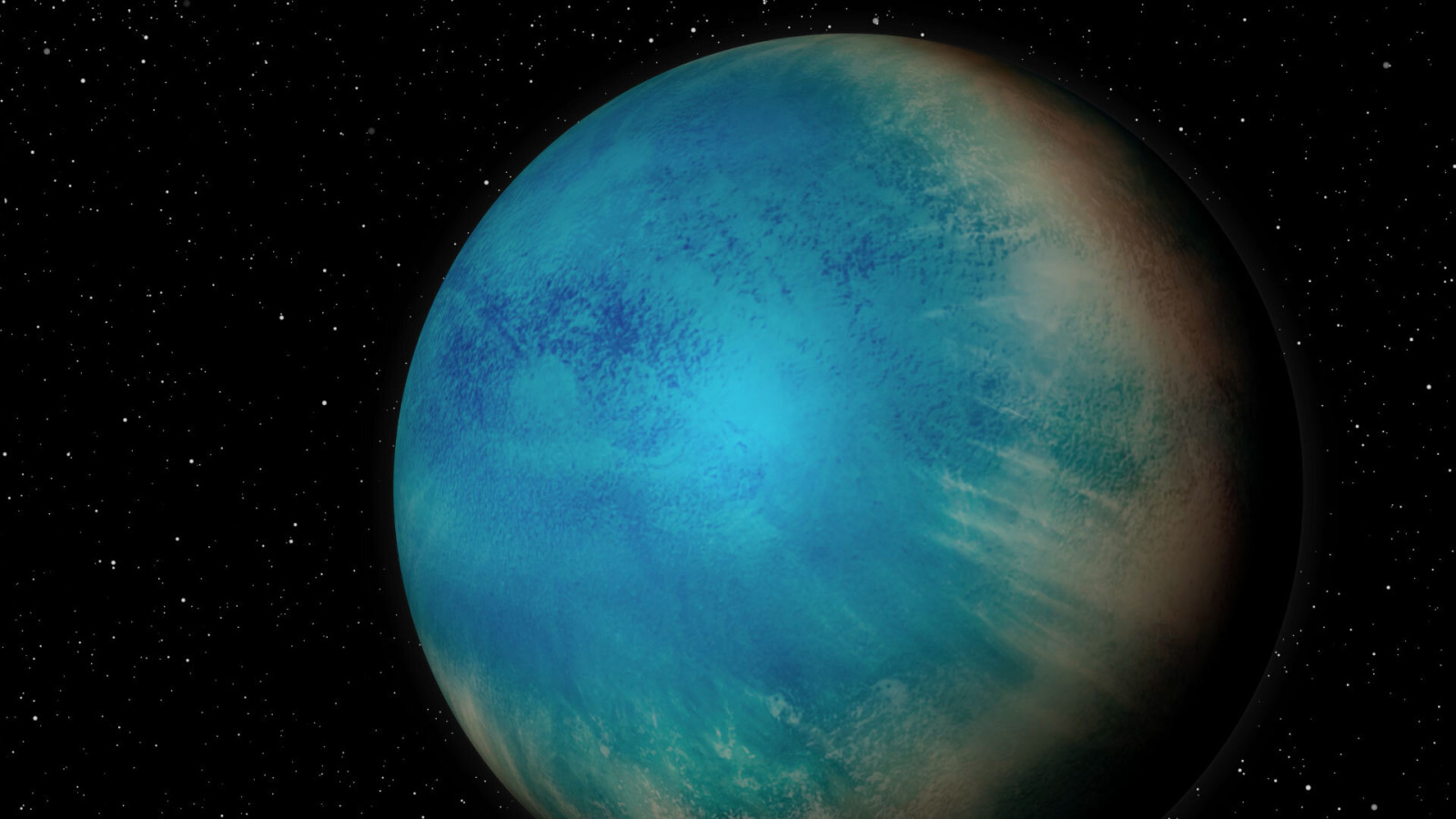
The team's analysis reveals its density is lower than typical rocky planets, setting TOI-1452 b apart from the majority of dense terrestrial exoplanets found to date.
Possible Ocean World With Vast Water Reserves
The highlight is the extraordinary volume of water TOI-1452 b may hold. According to the study published in The Astronomical Journal, Earth's water accounts for less than 1% of its total mass.
For TOI-1452 b, models crafted by Mykhaylo Plotnykov and Diana Valencia at the University of Toronto estimate water could comprise up to 30% of the planet’s mass.
According to the findings from Université de Montréal, TOI-1452 b ranks among the top ocean planet contenders known so far. Scientists draw parallels between its potential composition and icy moons in our Solar System like Ganymede, Callisto, Titan, and Enceladus.
Due to its nearness to Earth and favorable position, TOI-1452 b represents an excellent candidate for upcoming missions using the James Webb Space Telescope. Further investigation could unveil more about this extraordinary water-rich world.
- Categories:
- Astronomy



0 comments
Sign in to Comment