
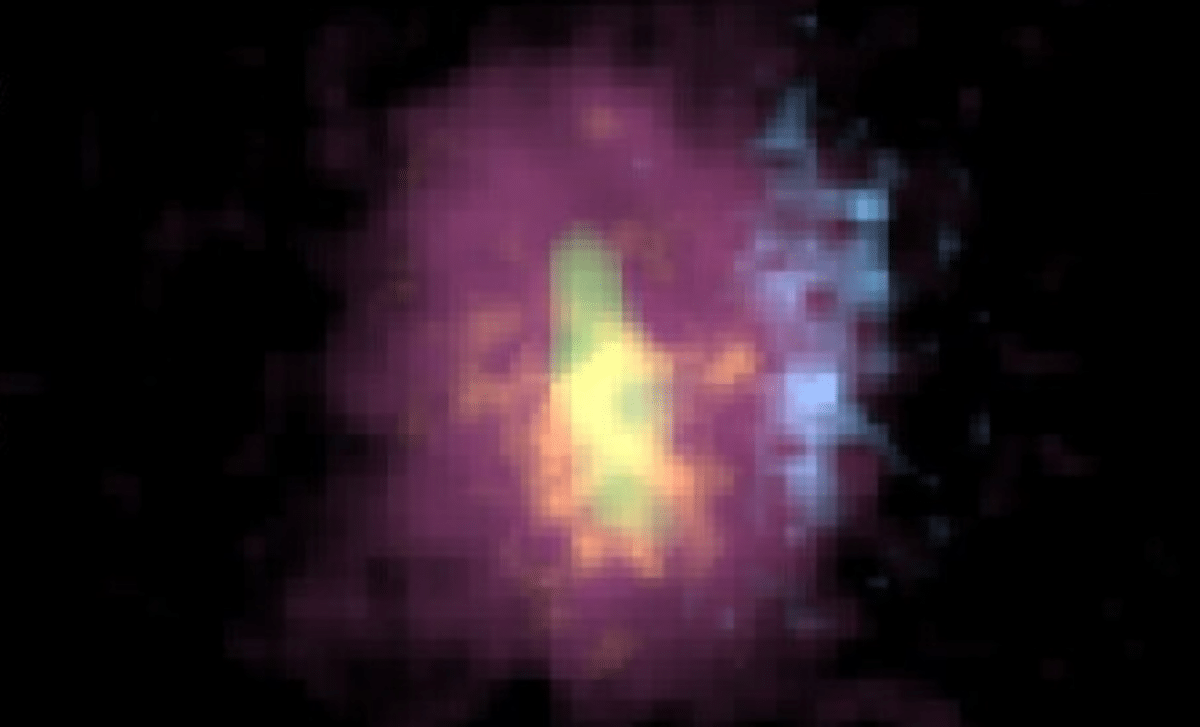
Utilizing the remarkable capabilities of the James Webb Space Telescope (JWST), researchers have identified a colossal stellar bar in the galaxy GN20, visible just 1.5 billion years following the Big Bang. This finding challenges established galaxy formation theories and reveals intricate early cosmic processes. The results were published in a recent submission to arXiv dated May 14, 2026.
Stellar Bars: Key Drivers in Galactic Development
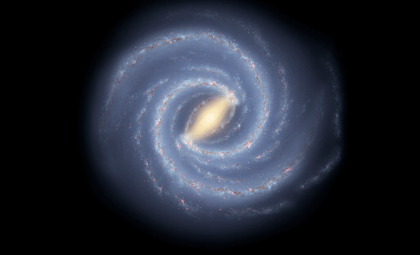
Stellar bars are elongated stellar formations that span a galaxy’s central region, rotating cohesively as a unit. These features are frequent in nearby galaxies and play a crucial role in their evolution by funneling gas toward the core. This inward movement sparks vigorous star formation, sustains supermassive black holes, and contributes to core buildup. Even our Milky Way showcases such a bar impacting its central architecture and star formation.
Contrary to expectations, the early universe was assumed unfavorable for bar formation due to the high gas content of nascent galaxies. Prevailing models suggested that bars needed billions of years to develop prominently, making the observation of a seven-kiloparsec bar in GN20 a groundbreaking surprise.

Unveiling Hidden Structures Using JWST
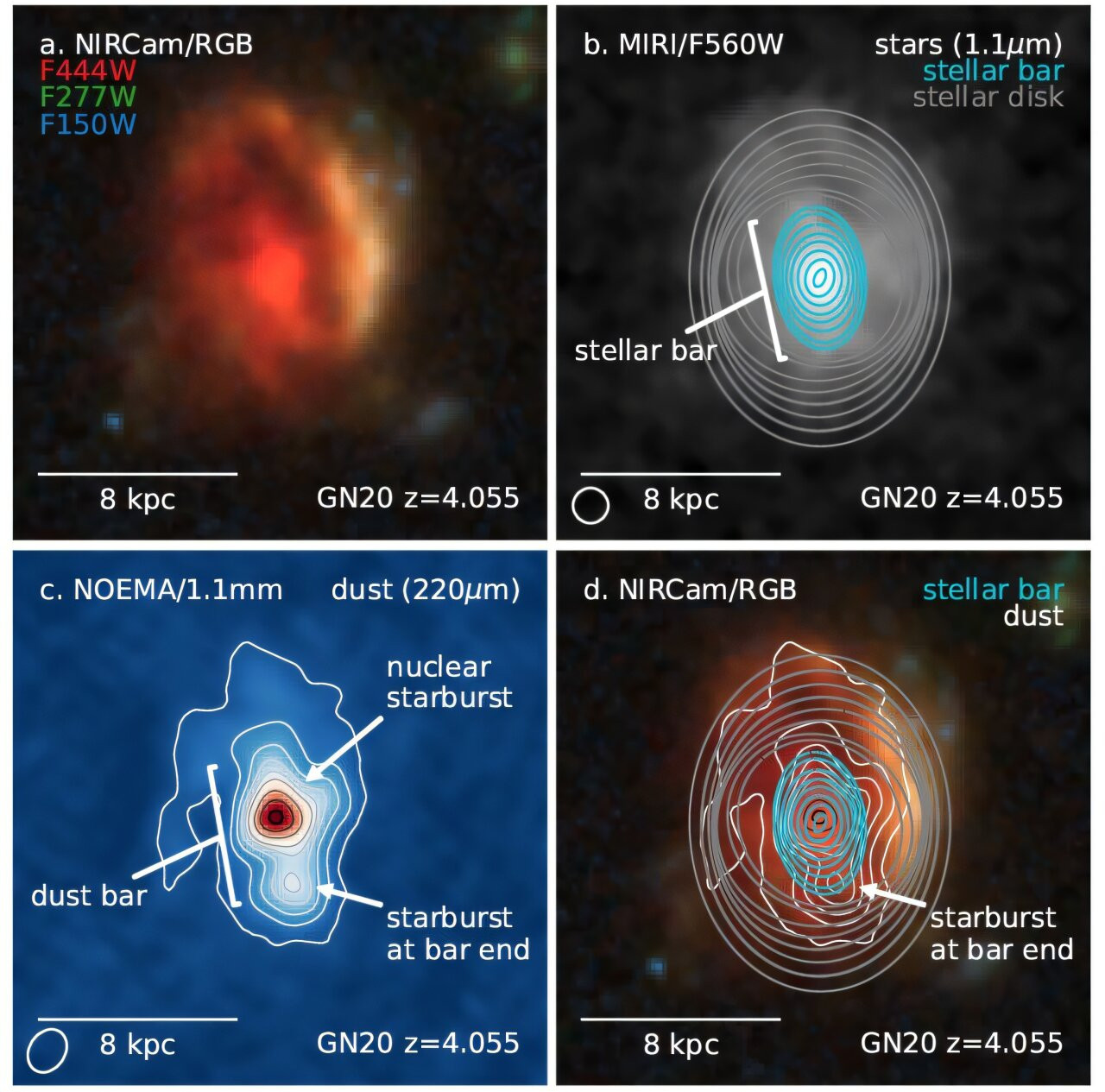
The galaxy GN20 is faint and heavily obscured by dust, complicating detailed observations. However, by employing JWST’s Mid-Infrared Instrument (MIRI) alongside its Near-Infrared Camera (NIRCam), researchers penetrated this dust, mapping the galaxy’s inner layout with extraordinary precision. These images clearly displayed a prominent bar-shaped structure, later corroborated by isophotal analysis, which assesses light distribution patterns radiating from the galactic core.
Complementary data collected by the Northern Extended Millimeter Array (NOEMA) demonstrated a remarkable correspondence between the stellar bar and a similarly shaped dust bar. This alignment highlights the complex interplay among stars, gas, and dust driving GN20’s evolutionary processes. Details of this study are available on arXiv, illustrating JWST’s ability to challenge prevailing beliefs about the early universe.
Redefining Galaxy Formation Paradigms
GN20’s bar contradicts traditional assumptions in several respects: bars in dense systems are prone to gravitational collapse; creating a seven-kiloparsec bar should require billions of years; and abundant gas was thought to hinder bar development.
“Our new results demonstrate that all three of these obstacles can be overcome by a single ingredient directly implicated by the observations: the presence of highly turbulent gas across the inner disk at high gas fraction,” the team writes in the paper.
It appears that turbulent gaseous conditions stabilize the bar and expedite its growth, offering a fresh perspective on how early galaxies could form such structures more rapidly than expected.
Impact of Bars on Star Formation
The stellar bar in GN20 is not just a passive feature but actively influences the galaxy’s evolution. Observations reveal that where the bar meets the outer disk, gas amasses, igniting regions of vigorous star formation. Additionally, the bar channels gas toward the core, fostering a nuclear starburst and potentially feeding a supermassive black hole.
“Part of this high SFR is likely being driven by the bar funneling gas and dust into the center, where it triggers an intense nuclear starburst in the gas-rich disk, and fuels the potential active galactic nucleus,” the team explains. With star formation rates surpassing 1,000 solar masses annually, GN20 offers a window into the rapid growth of massive early galaxies.
Crucial Clue to Galaxy Evolution
Galaxies like GN20 may represent an essential evolutionary phase rather than a brief anomaly. After central star-forming gas is exhausted, these galaxies could become quiescent, providing insights into how some massive galaxies today ceased star formation early in cosmic history.
This discovery highlights the transformative capabilities of JWST in uncovering hidden early-universe structures and deepens our understanding of how galaxies like GN20 surpassed traditional limits to build their stars and dense cores swiftly.
- Categories:
- Astronomy

0 comments
Sign in to Comment